Care Consideration: Cancer Risk Management
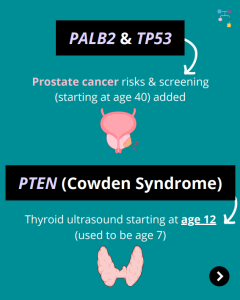
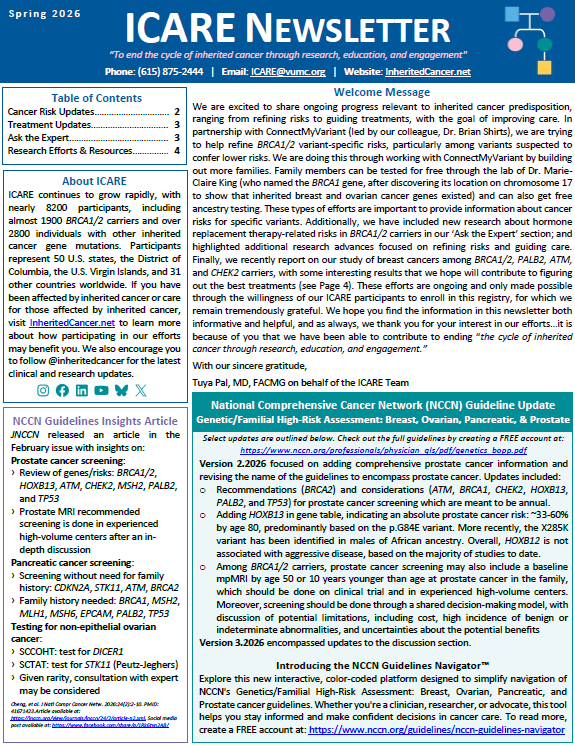
The National Comprehensive Cancer Network (NCCN) just released updated Genetic/Familial High-Risk Assessment: Breast, Ovarian, Pancreatic, and Prostate Cancer guidelines (Version 1.2026) today! There are many updates found in these new guidelines including updates to CHEK2, PALB2, TP53, and PTEN content as well as BRCA cancer risk management and much more. To learn more, check out …
Continue reading
Permanent link to this article: https://inheritedcancer.net/post071025/
ICARE Social Media Post June 2025
Lynch Syndrome: Showing the Importance of Family Testing
Cascade testing refers to testing “at-risk” family members for a gene mutation, once the mutation has been found in a family member. For Lynch syndrome, once family members get cascade testing, they can also benefit from screening, cancer prevention, and early detection strategies. Findings of a microsimulation model looking at the cost effectiveness of cascade …
Continue reading
Permanent link to this article: https://inheritedcancer.net/post061025/
ICARE Social Media Post June 2025 2025
PREMM5: Model to Estimate the Risk for Having Lynch Syndrome
PREMM5 is a model to estimate the risk for having Lynch Syndrome. PREMMplus is a model that estimates risks in 19-cancer risk genes, including Lynch Syndrome genes, BRCA, and other genes. A new study that compared PREMM5 and PREMMplus found that PREMMplus was just as good as PREMM5 in identifying patients with Lynch Syndrome. PREMMplus …
Continue reading
Permanent link to this article: https://inheritedcancer.net/post060325/
ICARE Social Media Post April 2025
Colonoscopy Age in Lynch Syndrome: MSH6 and PMS2 carriers
A new study evaluating colonoscopy age in Lynch Syndrome patients with MSH6 and PMS2 mutations found that among MSH6 and PMS2 carriers, cancer was commonly found, even in those under age 30. Current recommendations suggest delaying colonoscopy until age 30 in these carriers, thus study authors suggest that this might lead to missed opportunities for …
Continue reading
Permanent link to this article: https://inheritedcancer.net/post42725/